


One Week, Many Voices: How the World Came Together for Report It! Week 2026
21–27 September 2026 | Social Media Animal Cruelty Coalition (SMACC)
Every day, millions of people scroll past animal content on social media. Some videos are entertaining, others appear heartwarming, and some are difficult to watch. But behind the screen, animals may be experiencing fear, stress, exploitation, or deliberate harm. And often, the difference between what we see and what an animal experiences is not immediately obvious.
That is why, from 21–27 September 2026, the Social Media Animal Cruelty Coalition (SMACC), together with the Asia for Animals Coalition (AfA), its member organisations and supporters, brought people together for Report It! Week 2026.
Under the campaign hashtag #ReportIt2EndIt, organisations and individuals across different countries and communities joined a shared effort to raise awareness of online animal cruelty. Through educational posts, practical reporting guides, multilingual resources and conversations with their audiences, participants explored what online animal cruelty looks like and, more importantly, what people can do about it.
What made this year's campaign particularly meaningful was the variety of ways people chose to participate. Some focused on recognising harmful content, others challenged the normalisation of wildlife exploitation, while several helped bring the campaign to audiences who might otherwise never encounter it.
Together, these contributions demonstrated that addressing online animal cruelty is not the responsibility of one organisation or a single group of advocates. It requires awareness, collaboration and continued action from across the animal welfare community and beyond.
Looking beyond the screen: When animal cruelty doesn't look like cruelty
Online animal cruelty does not always look the way we expect it to. Some videos explicitly depict violence or suffering. Others are much harder to recognise. A wild animal interacting with a tourist, a primate dressed in human clothing or a video of an animal being deliberately frightened for entertainment may attract thousands of positive reactions. Fake animal rescue videos can be even more deceptive, presenting staged suffering as an act of compassion.
These videos can attract attention precisely because they are presented as entertainment, comedy or heartwarming moments. The more engaging they appear, the more likely people are to watch, comment on and share them.
Our own reactions can unintentionally contribute to the problem. People may comment to express concern, share a video to warn others or tag friends because they want more people to recognise what is happening. Yet social media platforms measure engagement, not intention. Every interaction can contribute to a video's visibility, regardless of whether the comment is supportive or critical.
This is particularly concerning when harmful content generates advertising revenue, attracts donations through deceptive rescue narratives, or encourages creators to produce similar videos.
During Report It! Week, SMACC member World Animal Protection highlighted this challenge through its campaign on wildlife content that appears cute but may conceal harmful interactions. Its message encouraged audiences to look beyond the immediate appeal of animal videos and consider the animals' actual experiences.
The distinction matters. What looks cute, extraordinary, or heartwarming to an audience may involve an animal experiencing fear, stress, or physical harm. A video rarely tells the whole story, especially when viewers cannot see what happened before filming or what happens after the camera stops.
Recognising this gap between what we see and what an animal may experience is an important first step towards more responsible online behaviour.
One campaign, many voices
Report It! Week is more than a campaign led by SMACC. It is an opportunity for organisations and individuals to bring their own expertise, perspectives and audiences into a shared conversation about online animal cruelty.
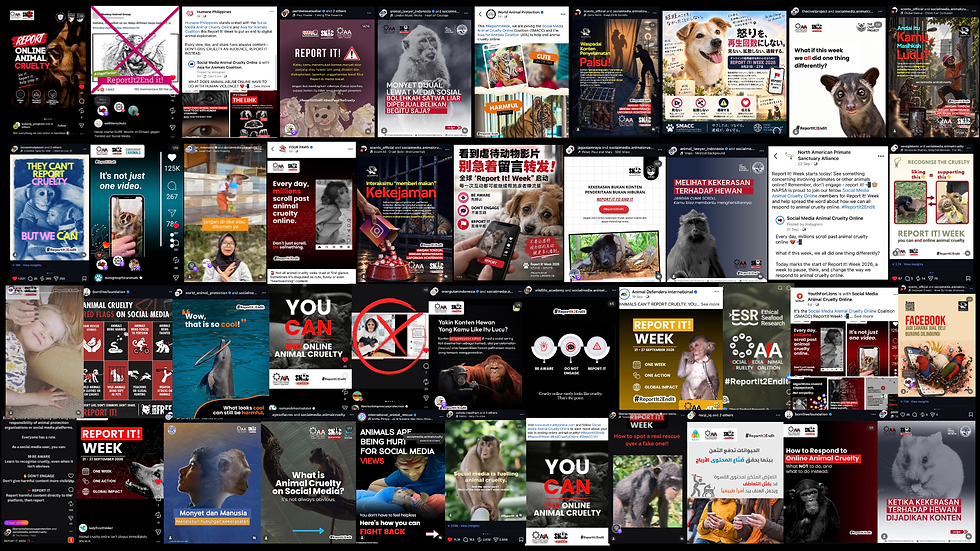
Throughout the week, participants took different approaches to communicating the issue. From educational content and practical reporting guidance to awareness campaigns and calls for action, each contribution helped bring attention to the different forms of online animal cruelty and how people can respond.
Organisations and individuals participating in the campaign included FOUR PAWS, World Animal Protection, Born Free Foundation, Eurogroup for Animals, Animal Defenders International, North American Primate Sanctuary Alliance (NAPSA), Youth for Lions, Humane Philippines, Lady Freethinker, Roots & Shoots Global, Ethical Seafood Research, Orangutan Indonesia, International Animal Rescue, Wild Welfare, and many more. Both SMACC members and organisations beyond the coalition contributed, reflecting broad support for addressing online animal cruelty.
The campaign also reached beyond English-speaking audiences, with materials shared in Chinese, Japanese, Arabic, Bahasa Indonesia and Malay. These multilingual contributions helped make campaign messages and reporting guidance more accessible to different communities, extending the conversation across linguistic and cultural boundaries.
The diversity of contributions reflects the importance of collaboration in tackling online animal cruelty. Organisations and individuals may have different areas of expertise, audiences and approaches, but they can come together around a shared goal: helping people recognise harmful content, avoid amplifying it and take action by reporting it.
We are grateful to all the organisations, partners and individuals who took part in Report It! Week 2026. Every shared resource, translated message and campaign contribution helped carry the message further. Together, we can continue raising awareness and encouraging meaningful action to protect animals online.
From awareness to action: Be Aware. Don't Engage. Report It!
At the heart of Report It! Week is a straightforward message: Be Aware. Don't Engage. Report It.
It may sound simple, but putting it into practice can be difficult, especially when a video provokes a strong emotional response. Seeing an animal being harmed can make people want to intervene immediately, defend the animal in the comments or share the content to raise awareness.
However, engagement can have unintended consequences. A video shared to condemn cruelty may reach a much larger audience. A comment expressing anger can still increase engagement, and repeated views can contribute to a video's performance.
This is why we encourage people to take a moment before interacting with potentially harmful content.
BE AWARE. Learn to recognise potentially harmful content, including animal abuse, exploitation, staged rescues and inappropriate interactions with wildlife. Remember that not all harmful content is immediately obvious.
DON'T ENGAGE. Avoid liking, commenting on or sharing harmful videos, even when your intention is to condemn them. Instead, share educational resources that explain the issue without amplifying the original content.
REPORT IT! Use the reporting tools provided by social media platforms. Where appropriate, also report the content to SMACC so it can be documented and considered for further action.
Reporting does not guarantee that a video or account will be removed. Platform policies, reporting categories, and moderation processes differ. Nevertheless, reporting allows platforms to review potentially harmful material and contributes to wider efforts to address it.
These actions are part of a broader effort to make online spaces safer for animals. Individual reporting, public education and platform accountability all have a role to play, and progress requires continued attention to each of them.
Taking the conversation further with SMACC 101
Awareness is an important starting point, but understanding how to respond is just as essential. That is why SMACC hosted SMACC 101: See It, Think, Act - Your Role in Ending Online Animal Cruelty as part of this year's campaign.
Held across two sessions for different time zones, the public webinar brought the campaign's central message into a dedicated learning space. The sessions explored online animal cruelty, the consequences of engaging with harmful content, and the actions people can take when they encounter it.
SMACC 101 also offered participants an opportunity to ask questions, exchange perspectives, and learn more about the work involved in addressing animal cruelty online.
We are grateful to everyone who attended, asked questions, and contributed to the discussions, as well as the speakers and coordinators who helped make the sessions possible.
For those who could not join us live, the recording is now available on YouTube.
We encourage animal welfare professionals, conservationists, students, researchers and anyone interested in animal protection to watch and share the recording. It can also serve as a resource for organisations that want to continue discussing online animal cruelty with their own communities.
The campaign may end, but the work doesn't
A week of coordinated action can help bring attention to an issue, but online animal cruelty does not disappear when the campaign ends. Harmful content continues to circulate, new audiences encounter it every day, and social media platforms continue to face challenges in identifying and moderating it.
This is why Report It! Week is part of a much broader effort. SMACC will continue working with its members and partners to document online animal cruelty, support reporting efforts, share educational resources and advocate for stronger platform responses.
There are also many ways to stay involved beyond the campaign.
Stay connected with SMACC. Follow our social media channels for research, educational resources, campaign updates and opportunities to participate in future initiatives. Sharing our content can help bring reliable information to people who might not otherwise encounter it.
Support the wider animal welfare community. SMACC works alongside organisations with different areas of expertise and experience. Supporting their work, engaging with their initiatives and sharing their resources can help strengthen efforts to address animal cruelty, both online and offline.
Make responsible engagement part of your everyday online behaviour. Think critically about animal content before interacting with it. Avoid amplifying harmful videos and help others understand why seemingly harmless engagement can have unintended consequences.
Help us reach new audiences. Educators, researchers, conservationists, content creators and animal welfare organisations all have opportunities to contribute to this conversation. Whether through sharing resources, developing educational materials or collaborating on future campaigns, there are many ways to get involved.
Support calls for stronger platform accountability. Public awareness and individual reporting are important, but platforms also need to take responsibility for the content shared through their services. Supporting SMACC's advocacy, including its Meta petition, is one way to help keep this issue on the agenda.
Support SMACC's work. Help us continue tackling online animal cruelty by supporting SMACC's work. Your donations can help sustain our research, advocacy, educational resources, and collaborative initiatives to make online spaces safer for animals. Every contribution helps us continue this work and build a stronger, more connected movement against online animal cruelty.
Stay informed. Stay involved. Be part of the conversation.
Report It! Week 2026 brought together organisations, advocates and individuals around a shared concern: the way animals are portrayed, treated and exploited on social media. The campaign showed how different approaches to education and advocacy can help make online animal cruelty more visible and encourage people to respond more responsibly.
To everyone who participated, shared campaign materials, created educational content, joined SMACC 101 or took the time to learn more about online animal cruelty, thank you.
We are especially grateful to our members, partners and supporters who brought their own perspectives, expertise and audiences to the campaign. Your contributions helped make Report It! Week a shared effort and extended the conversation beyond our own channels.
If you joined us this week, we hope you will stay involved. And if you have only just discovered SMACC, there is plenty more to explore.
Follow @socialmedia.animalcruelty for the latest research, educational resources, campaign updates, and opportunities to get involved. Visit EndCrueltyOnline.com to explore our resources, learn more about our work, and find out how you can help address online animal cruelty.
Whether you are an animal welfare professional, a conservationist, a researcher or simply someone who cares about animals, there is a place for you in this conversation.
Let's make sure that the next time someone encounters animal cruelty online, they know what to do.
Report It! Week may be over, but our commitment to ending online animal cruelty continues.
Be Aware. Don't engage. Report it!


